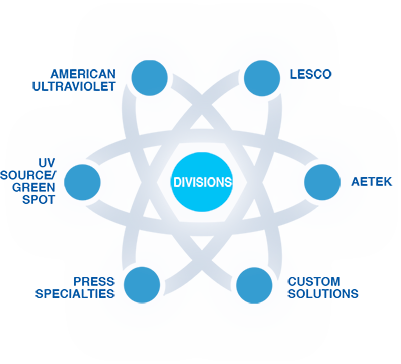
Originally founded in 1960, American Ultraviolet has seen the ultraviolet technology market, and the world as a whole, substantially change. We are proud to have earned the reputation as a leading manufacturer of UV technology, and we remain committed to providing the highest quality UV equipment at a fair price. Learn More.
Germicidal UVC fixtures have been safely operating in hospitals, laboratories, clean rooms, doctors' offices, commercial buildings, food processing plants, and residences throughout the world - any place a concern for clean air, liquids and surfaces exists. Ultraviolet curing equipment, used with UV-reactive chemistries (in adhesives, inks, and coatings), continues to help replace solvent-based chemistries and promote a greener environment. UV LED Curing further reduces environmental impact by removing mercury from the process.
Learn More About Germicidal UVC
Learn More About UV Curing
Since 1960 our focus has been, and always will be, on ultraviolet technology. We've engineered and manufactured standard, slightly modified, and custom ultraviolet solutions for so long that we know we offer the highest quality ultraviolet equipment at a fair price. Because we have a full staff of electrical, mechanical and controls engineers dedicated to UV technology, and in-house sheet metal fabrication capabilities, we provide all our customers with the UV solutions they need, not just the solutions we have.
Insightful Solutions. Remarkable Results.
Since 1960.